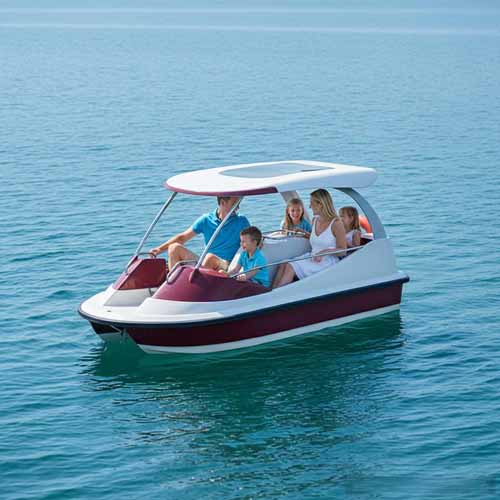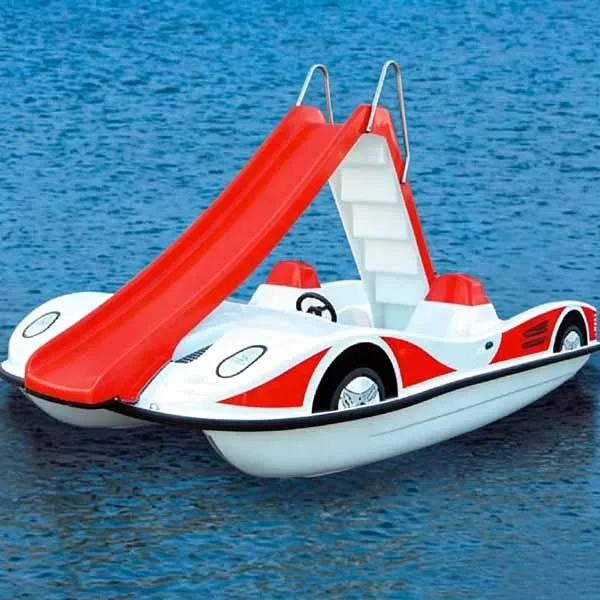

The current market for jet car primarily refers to watercraft that resemble land-based sports cars in appearance and offer high-speed performance or unique handling experiences. Based on their powertrain and intended use, they fall into three main categories:
1. Electric Recreational/Cruising jet car (Mainstream Consumer Grade)
This is the most common type found in scenic areas and mass tourism, emphasizing visual appeal and ease of use.
Core Features: Uses an automotive-style control scheme (steering wheel plus throttle lever), requiring no prior experience—ideal for absolute beginners.
Power & Range: Typically powered by 48V–72V lithium battery packs and brushless motors, ensuring quiet, eco-friendly operation; lead-acid versions offer a range of about 4–7 hours, while lithium versions last longer but come at a higher cost.
Capacity & Experience: Features a 3–5 seat layout with cushioned upholstery, designed for socializing and sightseeing; includes music playback capabilities; the low-profile, "hugging-the-water" stance delivers a striking visual impact.
Typical Use Cases: Family outings, couples' photo opportunities, and group gatherings on lakes or in calm bays.
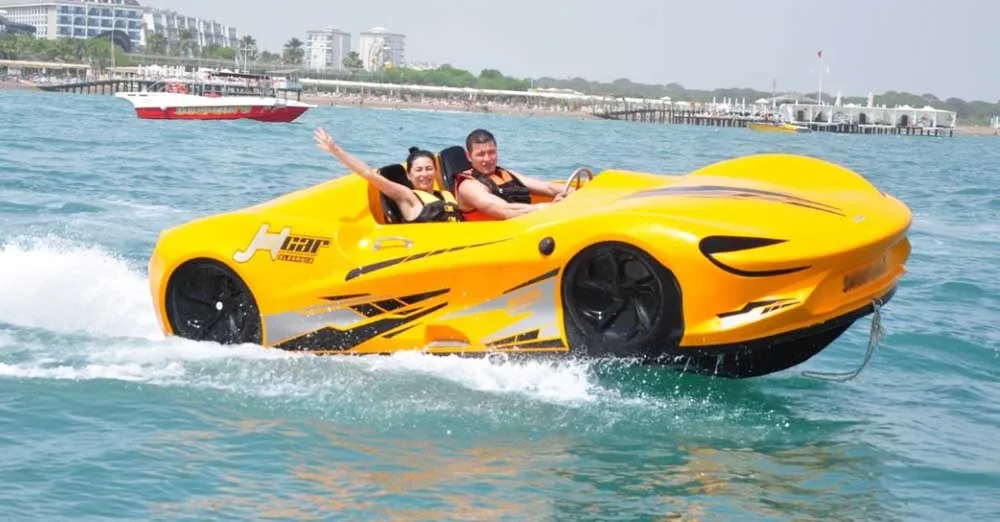
2. High-Performance Fuel-Powered Racing Jet car (Professional Sports Grade)
These craft are closer to traditional high-performance personal watercraft (PWC) or jet boats, emphasizing speed and the limits of handling.
Core Features: Controlled via handlebar throttles and body-weight shifting; requires advanced operating skills and supports dynamic maneuvers like rapid acceleration and drifting.
Power & Speed: Predominantly fuel-powered (50–170 hp), though some high-end models are fully electric (e.g., 150 hp electric outboard motors); top speeds can reach 35 knots (approx. 65 km/h) or higher.
Structure & Configuration: Lightweight hulls (carbon fiber or high-strength resin) equipped with Electronic Stability Control (ESC), adaptive suspension, and smart dashboards; designed primarily for solo or tandem racing experiences.
Typical Use Cases: Water sports competitions, professional club training, and thrill-seeking adventures.
3. Amphibious Concept Jet Car (Special/Concept Class)
Refers to vehicles genuinely capable of operating on both land and water; these are typically limited-edition custom builds or concept models.
Core Characteristics: Feature dual-mode capabilities—land travel via wheels or tracks and water navigation via propellers or water-jet propulsion—with complex mode-switching mechanisms.
Power and Performance: Usually powered by hybrid systems or independent electric motors (e.g., a tri-motor setup); land speeds can exceed 100 km/h, while water speeds generally range from 20 to 97 km/h.
Limitations and Current Status: Extremely high production costs (ranging from hundreds of thousands to over a million USD) and complex maintenance requirements; most have not entered mass production and are primarily used for military operations, disaster relief, or as collector's items for a select few wealthy individuals.